Overview
As UF Health continued its evolution into a statewide academic health system, I recognized an opportunity to rethink how employees communicate, connect and engage across an increasingly diverse and geographically dispersed organization. While email and the existing intranet remained essential communication tools, the potential to create a more connected, mobile-first employee experience that better reflected the way our teams consumes information and collaborates, feels increasingly necessary.
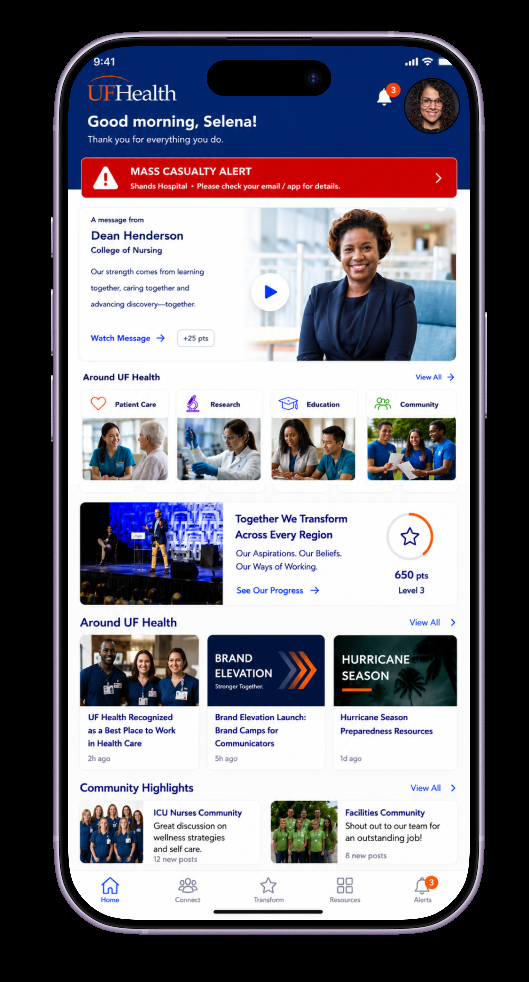
I developed a strategic concept for UF Health Bridge: named for it's predecessor (our intranet) this concept evolves that into a unified digital experience that brought together enterprise communications, community engagement, organizational culture, recognition and everyday employee resources into a single intuitive platform. This concept explored how technology could strengthen connection across regions while supporting organizational initiatives through timely communication, personalization and interactive engagement.
Although this concept ultimately served as a vision rather than a produced application, it helped inform broader conversations about the future evolution of The Bridge (intranet) and demonstrated how AI-assisted design and rapid prototyping can transform complex strategic ideas into tangible experiences that accelerate discussion, alignment and innovation.

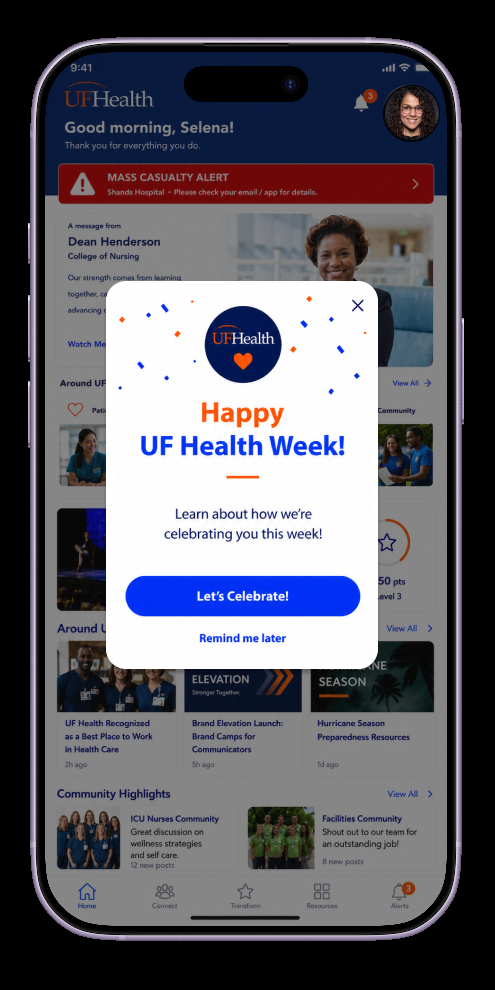

The Challenge
UF Health's internal communications ecosystem relied primarily on email and The Bridge, a longstanding desktop-focused intranet that serves as the organization's central hub for employee resources and information. While The Bridge is responsive for mobile devices, access is limited to employees connected to the UF Health network, either on-site or through a VPN. Its branding, user experience and functionality also reflected an earlier generation of intranet design, leaving opportunities to better support today's increasingly mobile, geographically dispersed workforce.
As UF Health continued to grow across multiple hospitals, regions, colleges and practice locations, I saw an opportunity to proactively rethink how employees connect with one another and with the organization. Rather than waiting for communication challenges to become larger organizational problems, I began exploring what a modern, mobile-first employee experience could look like one that reflected the full breadth of an academic health system.
This existing environment created several challenges:
• Critical announcements often failed to reach frontline staff who had limited or infrequent
access to email during their workday.
• Employees across newly integrated regions had few opportunities to connect, collaborate
and build community beyond their local teams.
• Communications teams leading enterprise initiatives, campaigns and organizational change
efforts relied heavily on email, limiting their ability to deliver timely notifications, drive
engagement or reinforce key messages through more interactive experiences.
• Organizational initiatives lacked engaging ways to encourage ongoing participation, learning,
recognition and culture-building.
• Resources and tools were spread across multiple systems, making it difficult for employees
to quickly find the information they needed, particularly from a mobile device.
access to email during their workday.
• Employees across newly integrated regions had few opportunities to connect, collaborate
and build community beyond their local teams.
• Communications teams leading enterprise initiatives, campaigns and organizational change
efforts relied heavily on email, limiting their ability to deliver timely notifications, drive
engagement or reinforce key messages through more interactive experiences.
• Organizational initiatives lacked engaging ways to encourage ongoing participation, learning,
recognition and culture-building.
• Resources and tools were spread across multiple systems, making it difficult for employees
to quickly find the information they needed, particularly from a mobile device.
The goal wasn't to redesign an intranet. I wanted to reimagine the employee experience through a modern, mobile-first lens. The vision was to create a unified platform that strengthened communication, culture and collaboration while intentionally reflecting UF Health's tripartite mission of patient care, education and research, along with the communities that make that mission possible. Rather than serving only clinicians or administrative staff, the experience was designed so every employee, regardless of role, could discover, celebrate and engage with the full organization from a single, personalized destination.


Strategic Opportunity
Rather than creating another communications tool, I envisioned a unified employee experience that would serve as the digital front door for every UF Health team member. The concept was built around five interconnected pillars designed to strengthen communication, engagement and organizational culture across the enterprise.
Inform
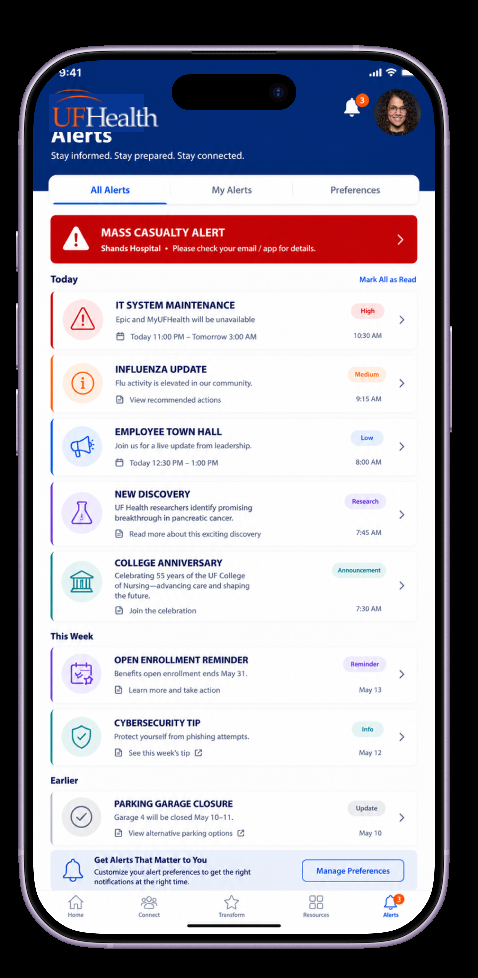
Deliver timely enterprise news, emergency alerts and executive communications through mobile-first notifications and personalized content, ensuring important information reaches employees wherever they work.
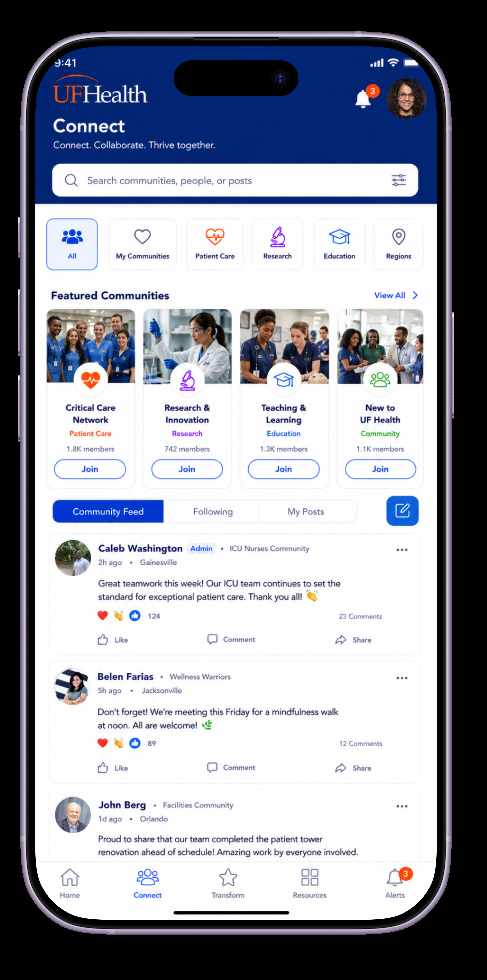
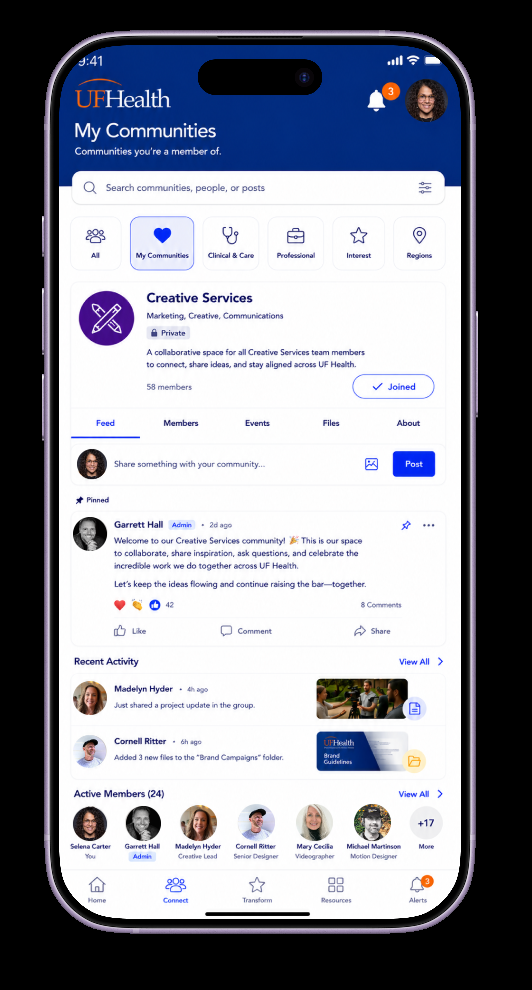
Connect
Foster collaboration and build community by connecting employees across departments, professions, regions and shared interests. By breaking down geographic and organizational silos, the platform would encourage knowledge sharing, relationship building and a stronger sense of one UF Health.
Transform
Support organizational priorities through interactive learning, gamification, recognition and engagement. From enterprise initiatives like Together We Transform to leadership videos, culture-building activities and professional development, the platform would encourage employees to actively participate rather than passively consume information.
Resources
Provide a centralized gateway to the tools employees use every day, including The Bridge, HR resources, policies, training, directories, schedules and other enterprise applications, reducing friction and making information easier to find.
Personalize
Create an experience tailored to each employee by surfacing relevant content based on their role, location, interests and organizational affiliations, helping ensure communications remain meaningful rather than one-size-fits-all.


From Strategy to Prototype
This project began not with interface design, but with a question:
How might we create a more connected, engaging and accessible employee experience for a rapidly growing academic health system?
Rather than immediately sketching screens, I began by exploring the opportunity strategically—identifying communication gaps, understanding user needs and envisioning how a mobile-first experience could strengthen communication, culture and collaboration across UF Health.
As the concept evolved through iterative exploration and feedback, so did its scope. What began as a solution to improve internal communication grew into a broader vision for an employee experience that reflected all facets of UF Health's mission, intentionally supporting patient care, research, education and community engagement within a single connected platform.
With that strategic foundation in place, I leveraged AI as a creative partner to accelerate ideation, explore interface concepts, rapidly iterate on design directions and visualize the experience. This allowed me to move quickly from abstract ideas to tangible screens while remaining firmly in control of the product vision, user experience and creative direction.
Working iteratively, I developed:
• A strategic framework centered around five core experience pillars
• Information architecture and navigation designed for a diverse academic health system workforce
• User journeys and interaction models focused on simplicity and accessibility
• High-fidelity interface concepts that balanced enterprise functionality with an approachable experience
• A fully clickable prototype in Figma to simulate an employee journey through the app
• Information architecture and navigation designed for a diverse academic health system workforce
• User journeys and interaction models focused on simplicity and accessibility
• High-fidelity interface concepts that balanced enterprise functionality with an approachable experience
• A fully clickable prototype in Figma to simulate an employee journey through the app
By combining strategic thinking, AI-assisted exploration and rapid prototyping, I was able to transform a complex organizational vision into an interactive experience in a matter of days rather than weeks. The prototype gave leadership something tangible to explore, discuss and react to, helping move the conversation from abstract possibilities toward actionable ideas that could help shape the future evolution of the employee experience at UF Health.



Project Outcome & Impact
The resulting prototype was shared with executive leadership and received enthusiastic support as a compelling vision for the future employee experience at UF Health. While the organization ultimately chose not to pursue a standalone mobile application at the time, many of the concepts helped inform broader conversations around modernizing The Bridge intranet and improving the way employees connect with communication, culture and organizational resources across the system.
Throughout the project, the concept continued to evolve through iterative exploration and leadership feedback. What began primarily as a communications platform expanded into a more holistic employee experience that intentionally reflected the full identity of an academic health system by bringing our staff across patient care, research, education and community engagement together within a single, connected experience.
Just as importantly, the project demonstrated a new way of approaching strategic concept development. By combining strategic design thinking with AI-assisted exploration and rapid prototyping, I was able to transform a complex organizational vision into a tangible, interactive experience in a matter of days. Rather than asking leadership to imagine an idea, I was able to place that vision directly into their hands, creating a shared understanding that accelerated discussion, generated enthusiasm and helped move the conversation from possibility to practical application.
For me, the greatest takeaway wasn't the prototype itself, but the process. It reinforced how emerging AI tools can amplify the work of creative leaders, not by replacing strategic thinking or design expertise, but by accelerating exploration, improving visualization and creating more meaningful conversations around innovation.
Explore the Prototype Below!
About the Prototype
The purpose of this prototype was to visualize a strategic vision: not finalize a production interface. To communicate the full breadth of the concept, some screens intentionally include more functionality than would ultimately be presented at one time. A production version would refine content hierarchy, streamline interactions and evolve through research, testing and iterative design.
The purpose of this prototype was to visualize a strategic vision: not finalize a production interface. To communicate the full breadth of the concept, some screens intentionally include more functionality than would ultimately be presented at one time. A production version would refine content hierarchy, streamline interactions and evolve through research, testing and iterative design.